Jewelry Is Quietly Reshaping How Fashion Tells Its Stories
Fashion trends rarely announce themselves all at once. They surface gradually, through repeated signals, subtle editorial choices, and the elements designers rely on to communicate meaning quickly.
In recent seasons, jewelry has moved into that role. Not as decoration, but as a narrative tool — one that establishes tone, identity, and cultural relevance before garments fully come into focus.
This shift is not dramatic. It is methodical. And once noticed, it becomes difficult to ignore.
From Accessory to Narrative Anchor
Across runway coverage and fashion editorials, jewelry increasingly appears as the element that defines a look’s intent.
Oversized chains suggest strength and presence. Vintage pendants introduce nostalgia. Asymmetric earrings disrupt balance deliberately. These choices are rarely incidental. They signal how the rest of the collection should be interpreted.
In this context, jewelry functions less as a complement and more as a framing device — setting emotional direction before silhouettes, fabrics, or color palettes are fully read.
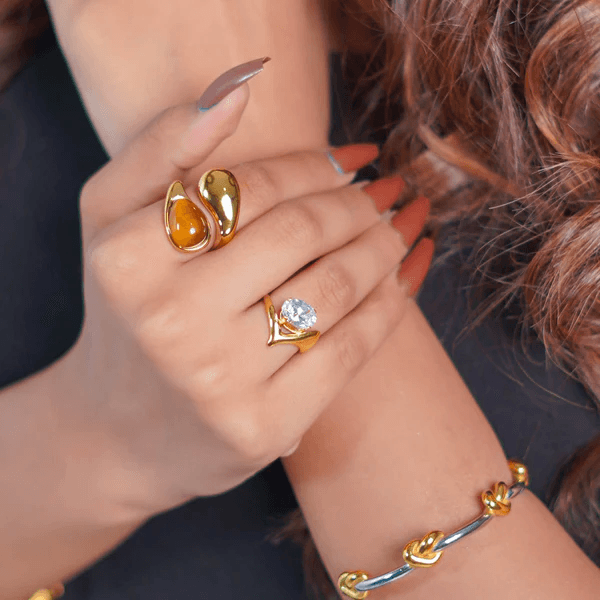
This shift is also visible in the work of contemporary jewelry brands focused on design-led fashion, where accessories function as narrative anchors rather than decorative afterthoughts.
Why Jewelry Becomes the First Place Trends Appear
New ideas in fashion rarely debut at full scale. They are tested.
Jewelry offers a controlled environment for experimentation:
- It is visually immediate
- It carries lower production risk
- It communicates symbolism efficiently
Because of this, shifts in aesthetics often surface in jewelry first, long before they are reflected in apparel. Editorial repetition of similar motifs is not coincidence — it is early validation.
What appears consistently in jewelry today often defines clothing tomorrow.
Memory, Visibility, and Editorial Priority
Fashion imagery competes in an increasingly compressed visual landscape. Within that environment, jewelry plays a specific role: memorability.
Faces, gestures, and close framing naturally draw attention to earrings, necklaces, and rings. As a result, jewelry becomes the visual reference point audiences recall, even when entire outfits fade from memory.
This is why editorial layouts position jewelry prominently — not to decorate, but to anchor recognition.
Artificial Jewelry as an Industry Feedback Loop
Artificial jewelry occupies a distinct position within fashion ecosystems.
Its faster production cycles and lower barriers to adoption allow it to respond immediately to emerging preferences. In doing so, it reflects what consumers are ready to accept — stylistically and symbolically — in real time.
Rather than trailing luxury, artificial jewelry often reveals which aesthetics resonate first, offering insight before higher-end interpretations follow.
Personalization as a Marker of Cultural Shift
Nameplates, charms, and symbolic motifs appear frequently in editorial features not because they are novel, but because they represent a broader shift toward identity-driven fashion.
Personalized jewelry establishes continuity in an environment defined by rapid change. It allows individuals to attach meaning to objects that might otherwise be transient.
In this way, personalization operates less as a trend and more as a stabilizing force within evolving style cycles.
How Sustainability Is Communicated Without Being Stated
Sustainability in jewelry is rarely announced directly in fashion narratives. Instead, it is embedded visually.
Editorial choices highlight:
- Raw or imperfect finishes
- Mixed or reclaimed materials
- Visible craftsmanship
These elements communicate longevity and intention without disrupting aesthetic flow. Sustainability, in this context, becomes part of the visual language rather than a separate message.
Jewelry as Fashion’s Interpretive Layer
While clothing continues to respond to seasons, jewelry increasingly responds to culture — to shifts in values, identity, and expression.
This is why it appears consistently at the center of editorial storytelling. Jewelry translates abstract cultural movement into tangible form, offering context before trends become explicit.
Understanding jewelry this way changes how fashion is read. It is no longer an addition, but an indicator — quietly shaping the direction of what comes next.